

ESTIA#
Reduction Workflows#

Angles and alignment#
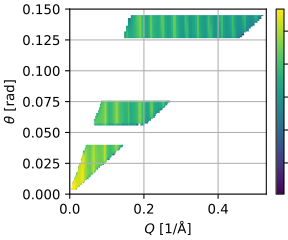
ESTIA computes angles in the laboratory x-z plane, with y vertical. The sample is aligned so that the central reflected beam hits the detector centre. After alignment, each sample rotation about y is accompanied by twice that rotation of the detector. Other alignment rotations stay fixed.
The sample mount angle (RawSampleRotation) is measured from laboratory +x
towards -z using the mount’s transformed local +x axis projected onto the x-z
plane. The sample may be tilted within its mount. Supply
SampleRotationOffset to calibrate the angle, for example from a fit to a known
critical edge. The corrected SampleRotation is the angle between the central
reflected beam and the sample surface. Sample and reference runs can have
separate offsets.
The detector reference is its transformed local +z direction. It must point
from the sample to the detector centre. divergence_angle measures each
outgoing ray’s angle from this direction, positive from laboratory +z towards
+x. The reflection angle is
theta = divergence_angle + sample_rotation.