
Frame Unwrapping#
Context#
At time-of-flight neutron sources recording event-mode, time-stamps of detected neutrons are written to files in an NXevent_data group. This contains two main time components, event_time_zero and event_time_offset. The sum of the two would typically yield the absolute detection time of the neutron. For computation of wavelengths or energies during data-reduction, a time-of-flight is required. In principle the time-of-flight could be equivalent to event_time_offset, and the
emission time of the neutron to event_time_zero. Since an actual computation of time-of-flight would require knowledge about chopper settings, detector positions, and whether the scattering of the sample is elastic or inelastic, this may however not be the case in practice. Instead, the data acquisition system may, e.g., record the time at which the proton pulse hits the target as event_time_zero, with event_time_offset representing the offset since then.
We refer to the process of “unwrapping” these time stamps into an actual time-of-flight as frame unwrapping, since event_time_offset “wraps around” with the period of the proton pulse and neutrons created by different proton pulses may be recorded with the same event_time_zero. The figures in the remainder of this document will clarify this.
[1]:
import plopp as pp
import scipp as sc
from scippneutron.chopper import DiskChopper
from ess.reduce.nexus.types import AnyRun, RawDetector, SampleRun, NeXusDetectorName
from ess.reduce.time_of_flight import *
import tof

Hz = sc.Unit("Hz")
deg = sc.Unit("deg")
meter = sc.Unit("m")
Default mode#
Often there is a 1:1 correspondence between source pulses and neutron pulses propagated to the sample and detectors.
In this first example:
We begin by creating a source of neutrons which mimics the ESS source.
We set up a single chopper with a single opening
We place 4 ‘monitors’ along the path of the neutrons (none of which absorb any neutrons)
[2]:
source = tof.Source(facility="ess", pulses=5)
chopper = tof.Chopper(
    frequency=14.0 * Hz,
    open=sc.array(dims=["cutout"], values=[0.0], unit="deg"),
    close=sc.array(dims=["cutout"], values=[3.0], unit="deg"),
    phase=85.0 * deg,
    distance=8.0 * meter,
    name="chopper",
)
detectors = [
    tof.Detector(distance=20.0 * meter, name="beam"),
    tof.Detector(distance=60.0 * meter, name="sample"),
    tof.Detector(distance=80.0 * meter, name="monitor"),
    tof.Detector(distance=108.0 * meter, name="detector"),
]

model = tof.Model(source=source, choppers=[chopper], detectors=detectors)
results = model.run()
pl = results.plot()

for i in range(2 * source.pulses):
    pl.ax.axvline(
        i * (1.0 / source.frequency).to(unit="us").value, color="k", ls="dotted"
    )
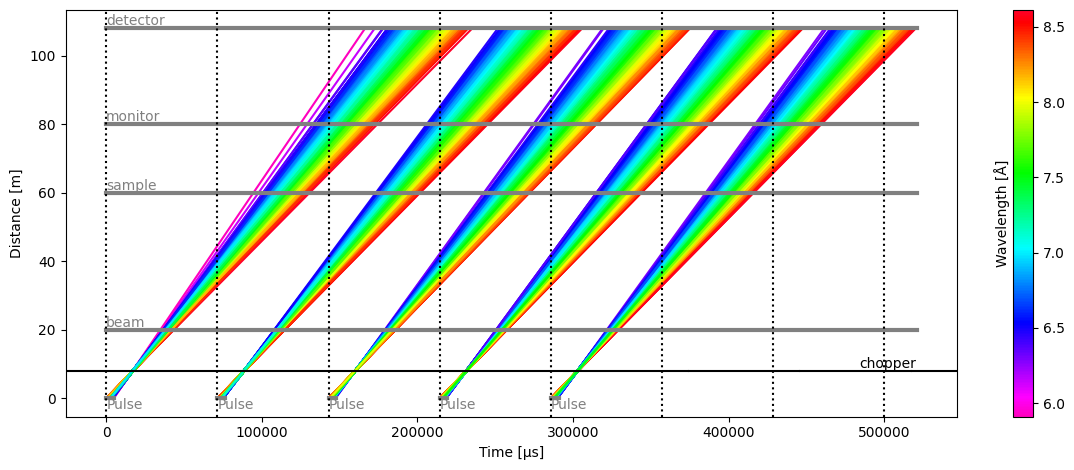
In the figure above, the dotted vertical lines represent the event_time_zero of each pulse, i.e. the start of a new origin for event_time_offset recorded at the various detectors.
The span between two dotted lines is called a ‘frame’.
The figure gives a good representation of the situation at each detector:
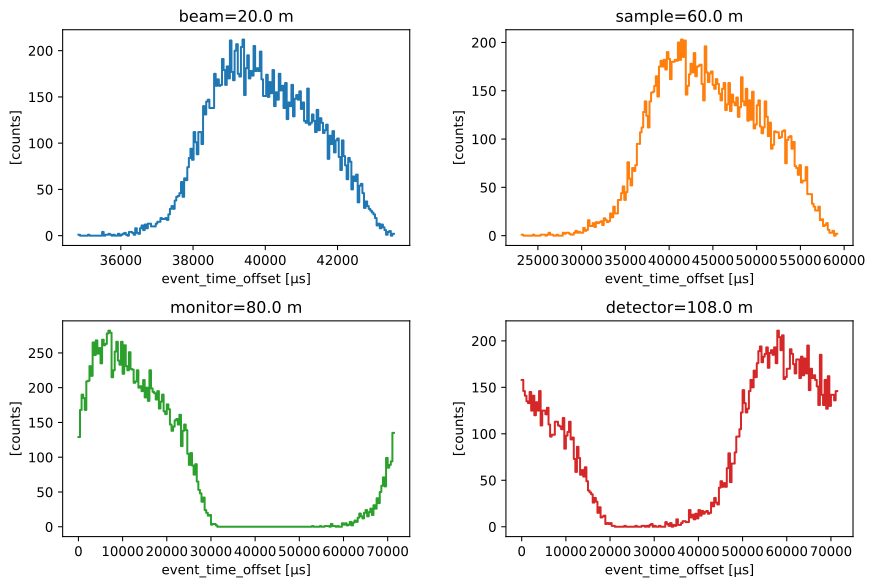
beam monitor: all the arrival times at the detector are inside the same frame within which the neutrons were created.
sample: all the arrival times are offset by one frame
monitor: most of the neutrons arrive with an offset of two frames, but a small amount of neutrons (shortest wavelengths) only have a 1-frame offset
detector: most of the neutrons arrive with an offset of two frames, but a small amount of neutrons (longest wavelengths) have a 3-frame offset
We can further illustrate this by making histograms of the event_time_offset of the neutrons for each detector:
[3]:
subplots = pp.tiled(2, 2, figsize=(9, 6))
nxevent_data = results.to_nxevent_data()
for i, det in enumerate(detectors):
    data = nxevent_data["detector_number", i]
    subplots[i // 2, i % 2] = (
        data.bins.concat()
        .hist(event_time_offset=200)
        .plot(title=f"{det.name}={det.distance:c}", color=f"C{i}")
    )
subplots
[3]:
Computing time-of-flight#
We describe in this section the workflow that computes time-of-flight, given event_time_zero and event_time_offset for neutron events, as well as the properties of the source pulse and the choppers in the beamline.
In short, we use a lookup table which can predict the wavelength (or time-of-flight) of the neutrons, according to their event_time_offset.
The workflow can be visualized as follows:
[4]:
wf = GenericTofWorkflow(run_types=[SampleRun], monitor_types=[])

wf[RawDetector[SampleRun]] = nxevent_data
wf[DetectorLtotal[SampleRun]] = nxevent_data.coords["Ltotal"]
wf[NeXusDetectorName] = "detector"

wf.visualize(TofDetector[SampleRun])
---------------------------------------------------------------------------
FileNotFoundError                         Traceback (most recent call last)
File ~/work/ess/ess/.pixi/envs/docs-essreduce/lib/python3.11/site-packages/graphviz/backend/execute.py:76, in run_check(cmd, input_lines, encoding, quiet, **kwargs)
     75         kwargs['stdout'] = kwargs['stderr'] = subprocess.PIPE
---> 76     proc = _run_input_lines(cmd, input_lines, kwargs=kwargs)
     77 else:

File ~/work/ess/ess/.pixi/envs/docs-essreduce/lib/python3.11/site-packages/graphviz/backend/execute.py:96, in _run_input_lines(cmd, input_lines, kwargs)
     95 def _run_input_lines(cmd, input_lines, *, kwargs):
---> 96     popen = subprocess.Popen(cmd, stdin=subprocess.PIPE, **kwargs)
     98     stdin_write = popen.stdin.write

File ~/work/ess/ess/.pixi/envs/docs-essreduce/lib/python3.11/subprocess.py:1026, in Popen.__init__(self, args, bufsize, executable, stdin, stdout, stderr, preexec_fn, close_fds, shell, cwd, env, universal_newlines, startupinfo, creationflags, restore_signals, start_new_session, pass_fds, user, group, extra_groups, encoding, errors, text, umask, pipesize, process_group)
   1023             self.stderr = io.TextIOWrapper(self.stderr,
   1024                     encoding=encoding, errors=errors)
-> 1026     self._execute_child(args, executable, preexec_fn, close_fds,
   1027                         pass_fds, cwd, env,
   1028                         startupinfo, creationflags, shell,
   1029                         p2cread, p2cwrite,
   1030                         c2pread, c2pwrite,
   1031                         errread, errwrite,
   1032                         restore_signals,
   1033                         gid, gids, uid, umask,
   1034                         start_new_session, process_group)
   1035 except:
   1036     # Cleanup if the child failed starting.

File ~/work/ess/ess/.pixi/envs/docs-essreduce/lib/python3.11/subprocess.py:1955, in Popen._execute_child(self, args, executable, preexec_fn, close_fds, pass_fds, cwd, env, startupinfo, creationflags, shell, p2cread, p2cwrite, c2pread, c2pwrite, errread, errwrite, restore_signals, gid, gids, uid, umask, start_new_session, process_group)
   1954 if err_filename is not None:
-> 1955     raise child_exception_type(errno_num, err_msg, err_filename)
   1956 else:

FileNotFoundError: [Errno 2] No such file or directory: PosixPath('dot')

The above exception was the direct cause of the following exception:

ExecutableNotFound                        Traceback (most recent call last)
File ~/work/ess/ess/.pixi/envs/docs-essreduce/lib/python3.11/site-packages/IPython/core/formatters.py:1036, in MimeBundleFormatter.__call__(self, obj, include, exclude)
   1033     method = get_real_method(obj, self.print_method)
   1035     if method is not None:
-> 1036         return method(include=include, exclude=exclude)
   1037     return None
   1038 else:

File ~/work/ess/ess/.pixi/envs/docs-essreduce/lib/python3.11/site-packages/graphviz/jupyter_integration.py:98, in JupyterIntegration._repr_mimebundle_(self, include, exclude, **_)
     96 include = set(include) if include is not None else {self._jupyter_mimetype}
     97 include -= set(exclude or [])
---> 98 return {mimetype: getattr(self, method_name)()
     99         for mimetype, method_name in MIME_TYPES.items()
    100         if mimetype in include}

File ~/work/ess/ess/.pixi/envs/docs-essreduce/lib/python3.11/site-packages/graphviz/jupyter_integration.py:98, in <dictcomp>(.0)
     96 include = set(include) if include is not None else {self._jupyter_mimetype}
     97 include -= set(exclude or [])
---> 98 return {mimetype: getattr(self, method_name)()
     99         for mimetype, method_name in MIME_TYPES.items()
    100         if mimetype in include}

File ~/work/ess/ess/.pixi/envs/docs-essreduce/lib/python3.11/site-packages/graphviz/jupyter_integration.py:112, in JupyterIntegration._repr_image_svg_xml(self)
    110 def _repr_image_svg_xml(self) -> str:
    111     """Return the rendered graph as SVG string."""
--> 112     return self.pipe(format='svg', encoding=SVG_ENCODING)

File ~/work/ess/ess/.pixi/envs/docs-essreduce/lib/python3.11/site-packages/graphviz/piping.py:104, in Pipe.pipe(self, format, renderer, formatter, neato_no_op, quiet, engine, encoding)
     55 def pipe(self,
     56          format: typing.Optional[str] = None,
     57          renderer: typing.Optional[str] = None,
   (...)     61          engine: typing.Optional[str] = None,
     62          encoding: typing.Optional[str] = None) -> typing.Union[bytes, str]:
     63     """Return the source piped through the Graphviz layout command.
     64
     65     Args:
   (...)    102         '<?xml version='
    103     """
--> 104     return self._pipe_legacy(format,
    105                              renderer=renderer,
    106                              formatter=formatter,
    107                              neato_no_op=neato_no_op,
    108                              quiet=quiet,
    109                              engine=engine,
    110                              encoding=encoding)

File ~/work/ess/ess/.pixi/envs/docs-essreduce/lib/python3.11/site-packages/graphviz/_tools.py:185, in deprecate_positional_args.<locals>.decorator.<locals>.wrapper(*args, **kwargs)
    177     wanted = ', '.join(f'{name}={value!r}'
    178                        for name, value in deprecated.items())
    179     warnings.warn(f'The signature of {func_name} will be reduced'
    180                   f' to {supported_number} positional arg{s_}{qualification}'
    181                   f' {list(supported)}: pass {wanted} as keyword arg{s_}',
    182                   stacklevel=stacklevel,
    183                   category=category)
--> 185 return func(*args, **kwargs)

File ~/work/ess/ess/.pixi/envs/docs-essreduce/lib/python3.11/site-packages/graphviz/piping.py:121, in Pipe._pipe_legacy(self, format, renderer, formatter, neato_no_op, quiet, engine, encoding)
    112 @_tools.deprecate_positional_args(supported_number=1, ignore_arg='self')
    113 def _pipe_legacy(self,
    114                  format: typing.Optional[str] = None,
   (...)    119                  engine: typing.Optional[str] = None,
    120                  encoding: typing.Optional[str] = None) -> typing.Union[bytes, str]:
--> 121     return self._pipe_future(format,
    122                              renderer=renderer,
    123                              formatter=formatter,
    124                              neato_no_op=neato_no_op,
    125                              quiet=quiet,
    126                              engine=engine,
    127                              encoding=encoding)

File ~/work/ess/ess/.pixi/envs/docs-essreduce/lib/python3.11/site-packages/graphviz/piping.py:149, in Pipe._pipe_future(self, format, renderer, formatter, neato_no_op, quiet, engine, encoding)
    146 if encoding is not None:
    147     if codecs.lookup(encoding) is codecs.lookup(self.encoding):
    148         # common case: both stdin and stdout need the same encoding
--> 149         return self._pipe_lines_string(*args, encoding=encoding, **kwargs)
    150     try:
    151         raw = self._pipe_lines(*args, input_encoding=self.encoding, **kwargs)

File ~/work/ess/ess/.pixi/envs/docs-essreduce/lib/python3.11/site-packages/graphviz/backend/piping.py:212, in pipe_lines_string(engine, format, input_lines, encoding, renderer, formatter, neato_no_op, quiet)
    206 cmd = dot_command.command(engine, format,
    207                           renderer=renderer,
    208                           formatter=formatter,
    209                           neato_no_op=neato_no_op)
    210 kwargs = {'input_lines': input_lines, 'encoding': encoding}
--> 212 proc = execute.run_check(cmd, capture_output=True, quiet=quiet, **kwargs)
    213 return proc.stdout

File ~/work/ess/ess/.pixi/envs/docs-essreduce/lib/python3.11/site-packages/graphviz/backend/execute.py:81, in run_check(cmd, input_lines, encoding, quiet, **kwargs)
     79 except OSError as e:
     80     if e.errno == errno.ENOENT:
---> 81         raise ExecutableNotFound(cmd) from e
     82     raise
     84 if not quiet and proc.stderr:

ExecutableNotFound: failed to execute PosixPath('dot'), make sure the Graphviz executables are on your systems' PATH
[4]:
<graphviz.graphs.Digraph at 0x7f51d470e710>
By default, the workflow tries to load a TofLookupTable from a file.
In this notebook, instead of using such a pre-made file, we will build our own lookup table from the chopper information and apply it to the workflow.
Create the lookup table#
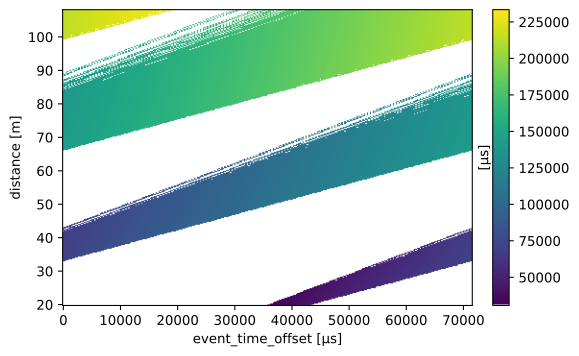
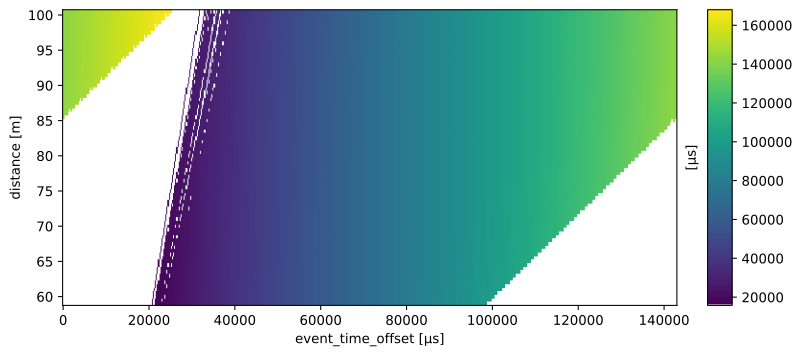
The chopper information is used to construct a lookup table that provides an estimate of the real time-of-flight as a function of time-of-arrival.
The Tof package can be used to propagate a pulse of neutrons through the chopper system to the detectors, and predict the most likely neutron wavelength for a given time-of-arrival. More advanced programs such as McStas can of course also be used for even better results.
We typically have hundreds of thousands of pixels in an instrument, but it is actually not necessary to propagate the neutrons to 105 detectors.
Instead, we make a table that spans the entire range of distances of all the pixels, with a modest resolution, and use a linear interpolation for values that lie between the points in the table.
To create the table, we thus:
run a simulation where a pulse of neutrons passes through the choppers and reaches the sample (or any location after the last chopper)
propagate the neutrons from the sample to a range of distances that span the minimum and maximum pixel distance from the sample (assuming neutron wavelengths do not change)
bin the neutrons in both distance and time-of-arrival (yielding a 2D binned data array)
compute the (weighted) mean wavelength inside each bin
convert the wavelengths to a real time-of-flight to give our final lookup table
This is done using a dedicated workflow:
[5]:
lut_wf = TofLookupTableWorkflow()
lut_wf[LtotalRange] = detectors[0].distance, detectors[-1].distance
lut_wf[DiskChoppers[AnyRun]] = {
    "chopper": DiskChopper(
        frequency=-chopper.frequency,
        beam_position=sc.scalar(0.0, unit="deg"),
        phase=-chopper.phase,
        axle_position=sc.vector(
            value=[0, 0, chopper.distance.value], unit=chopper.distance.unit
        ),
        slit_begin=chopper.open,
        slit_end=chopper.close,
        slit_height=sc.scalar(10.0, unit="cm"),
        radius=sc.scalar(30.0, unit="cm"),
    )
}
lut_wf[SourcePosition] = sc.vector([0, 0, 0], unit="m")

lut_wf.visualize(TofLookupTable)
---------------------------------------------------------------------------
FileNotFoundError                         Traceback (most recent call last)
File ~/work/ess/ess/.pixi/envs/docs-essreduce/lib/python3.11/site-packages/graphviz/backend/execute.py:76, in run_check(cmd, input_lines, encoding, quiet, **kwargs)
     75         kwargs['stdout'] = kwargs['stderr'] = subprocess.PIPE
---> 76     proc = _run_input_lines(cmd, input_lines, kwargs=kwargs)
     77 else:

File ~/work/ess/ess/.pixi/envs/docs-essreduce/lib/python3.11/site-packages/graphviz/backend/execute.py:96, in _run_input_lines(cmd, input_lines, kwargs)
     95 def _run_input_lines(cmd, input_lines, *, kwargs):
---> 96     popen = subprocess.Popen(cmd, stdin=subprocess.PIPE, **kwargs)
     98     stdin_write = popen.stdin.write

File ~/work/ess/ess/.pixi/envs/docs-essreduce/lib/python3.11/subprocess.py:1026, in Popen.__init__(self, args, bufsize, executable, stdin, stdout, stderr, preexec_fn, close_fds, shell, cwd, env, universal_newlines, startupinfo, creationflags, restore_signals, start_new_session, pass_fds, user, group, extra_groups, encoding, errors, text, umask, pipesize, process_group)
   1023             self.stderr = io.TextIOWrapper(self.stderr,
   1024                     encoding=encoding, errors=errors)
-> 1026     self._execute_child(args, executable, preexec_fn, close_fds,
   1027                         pass_fds, cwd, env,
   1028                         startupinfo, creationflags, shell,
   1029                         p2cread, p2cwrite,
   1030                         c2pread, c2pwrite,
   1031                         errread, errwrite,
   1032                         restore_signals,
   1033                         gid, gids, uid, umask,
   1034                         start_new_session, process_group)
   1035 except:
   1036     # Cleanup if the child failed starting.

File ~/work/ess/ess/.pixi/envs/docs-essreduce/lib/python3.11/subprocess.py:1955, in Popen._execute_child(self, args, executable, preexec_fn, close_fds, pass_fds, cwd, env, startupinfo, creationflags, shell, p2cread, p2cwrite, c2pread, c2pwrite, errread, errwrite, restore_signals, gid, gids, uid, umask, start_new_session, process_group)
   1954 if err_filename is not None:
-> 1955     raise child_exception_type(errno_num, err_msg, err_filename)
   1956 else:

FileNotFoundError: [Errno 2] No such file or directory: PosixPath('dot')

The above exception was the direct cause of the following exception:

ExecutableNotFound                        Traceback (most recent call last)
File ~/work/ess/ess/.pixi/envs/docs-essreduce/lib/python3.11/site-packages/IPython/core/formatters.py:1036, in MimeBundleFormatter.__call__(self, obj, include, exclude)
   1033     method = get_real_method(obj, self.print_method)
   1035     if method is not None:
-> 1036         return method(include=include, exclude=exclude)
   1037     return None
   1038 else:

File ~/work/ess/ess/.pixi/envs/docs-essreduce/lib/python3.11/site-packages/graphviz/jupyter_integration.py:98, in JupyterIntegration._repr_mimebundle_(self, include, exclude, **_)
     96 include = set(include) if include is not None else {self._jupyter_mimetype}
     97 include -= set(exclude or [])
---> 98 return {mimetype: getattr(self, method_name)()
     99         for mimetype, method_name in MIME_TYPES.items()
    100         if mimetype in include}

File ~/work/ess/ess/.pixi/envs/docs-essreduce/lib/python3.11/site-packages/graphviz/jupyter_integration.py:98, in <dictcomp>(.0)
     96 include = set(include) if include is not None else {self._jupyter_mimetype}
     97 include -= set(exclude or [])
---> 98 return {mimetype: getattr(self, method_name)()
     99         for mimetype, method_name in MIME_TYPES.items()
    100         if mimetype in include}

File ~/work/ess/ess/.pixi/envs/docs-essreduce/lib/python3.11/site-packages/graphviz/jupyter_integration.py:112, in JupyterIntegration._repr_image_svg_xml(self)
    110 def _repr_image_svg_xml(self) -> str:
    111     """Return the rendered graph as SVG string."""
--> 112     return self.pipe(format='svg', encoding=SVG_ENCODING)

File ~/work/ess/ess/.pixi/envs/docs-essreduce/lib/python3.11/site-packages/graphviz/piping.py:104, in Pipe.pipe(self, format, renderer, formatter, neato_no_op, quiet, engine, encoding)
     55 def pipe(self,
     56          format: typing.Optional[str] = None,
     57          renderer: typing.Optional[str] = None,
   (...)     61          engine: typing.Optional[str] = None,
     62          encoding: typing.Optional[str] = None) -> typing.Union[bytes, str]:
     63     """Return the source piped through the Graphviz layout command.
     64
     65     Args:
   (...)    102         '<?xml version='
    103     """
--> 104     return self._pipe_legacy(format,
    105                              renderer=renderer,
    106                              formatter=formatter,
    107                              neato_no_op=neato_no_op,
    108                              quiet=quiet,
    109                              engine=engine,
    110                              encoding=encoding)

File ~/work/ess/ess/.pixi/envs/docs-essreduce/lib/python3.11/site-packages/graphviz/_tools.py:185, in deprecate_positional_args.<locals>.decorator.<locals>.wrapper(*args, **kwargs)
    177     wanted = ', '.join(f'{name}={value!r}'
    178                        for name, value in deprecated.items())
    179     warnings.warn(f'The signature of {func_name} will be reduced'
    180                   f' to {supported_number} positional arg{s_}{qualification}'
    181                   f' {list(supported)}: pass {wanted} as keyword arg{s_}',
    182                   stacklevel=stacklevel,
    183                   category=category)
--> 185 return func(*args, **kwargs)

File ~/work/ess/ess/.pixi/envs/docs-essreduce/lib/python3.11/site-packages/graphviz/piping.py:121, in Pipe._pipe_legacy(self, format, renderer, formatter, neato_no_op, quiet, engine, encoding)
    112 @_tools.deprecate_positional_args(supported_number=1, ignore_arg='self')
    113 def _pipe_legacy(self,
    114                  format: typing.Optional[str] = None,
   (...)    119                  engine: typing.Optional[str] = None,
    120                  encoding: typing.Optional[str] = None) -> typing.Union[bytes, str]:
--> 121     return self._pipe_future(format,
    122                              renderer=renderer,
    123                              formatter=formatter,
    124                              neato_no_op=neato_no_op,
    125                              quiet=quiet,
    126                              engine=engine,
    127                              encoding=encoding)

File ~/work/ess/ess/.pixi/envs/docs-essreduce/lib/python3.11/site-packages/graphviz/piping.py:149, in Pipe._pipe_future(self, format, renderer, formatter, neato_no_op, quiet, engine, encoding)
    146 if encoding is not None:
    147     if codecs.lookup(encoding) is codecs.lookup(self.encoding):
    148         # common case: both stdin and stdout need the same encoding
--> 149         return self._pipe_lines_string(*args, encoding=encoding, **kwargs)
    150     try:
    151         raw = self._pipe_lines(*args, input_encoding=self.encoding, **kwargs)

File ~/work/ess/ess/.pixi/envs/docs-essreduce/lib/python3.11/site-packages/graphviz/backend/piping.py:212, in pipe_lines_string(engine, format, input_lines, encoding, renderer, formatter, neato_no_op, quiet)
    206 cmd = dot_command.command(engine, format,
    207                           renderer=renderer,
    208                           formatter=formatter,
    209                           neato_no_op=neato_no_op)
    210 kwargs = {'input_lines': input_lines, 'encoding': encoding}
--> 212 proc = execute.run_check(cmd, capture_output=True, quiet=quiet, **kwargs)
    213 return proc.stdout

File ~/work/ess/ess/.pixi/envs/docs-essreduce/lib/python3.11/site-packages/graphviz/backend/execute.py:81, in run_check(cmd, input_lines, encoding, quiet, **kwargs)
     79 except OSError as e:
     80     if e.errno == errno.ENOENT:
---> 81         raise ExecutableNotFound(cmd) from e
     82     raise
     84 if not quiet and proc.stderr:

ExecutableNotFound: failed to execute PosixPath('dot'), make sure the Graphviz executables are on your systems' PATH
[5]:
<graphviz.graphs.Digraph at 0x7f51d0a5fb50>
The table can be computed, and visualized as follows:
[6]:
table = lut_wf.compute(TofLookupTable)
table.plot()
[6]:
Computing time-of-flight from the lookup#
We now use the above table to perform a bilinear interpolation and compute the time-of-flight of every neutron. We set the newly computed lookup table as the TofLookupTable onto the workflow wf.
Looking at the workflow visualization of the GenericTofWorkflow above, we also need to set a value for the LookupTableRelativeErrorThreshold parameter. This puts a cap on wavelength uncertainties: if there are regions in the table where neutrons with different wavelengths are overlapping, the uncertainty on the predicted wavelength for a given neutron time of arrival will be large. In some cases, it is desirable to throw away these neutrons by setting a low uncertainty threshold. Here,
we do not have that issue as the chopper in the beamline is ensuring that neutron rays are not overlapping, and we thus set the threshold to infinity.
[7]:
# Set the computed lookup table on the original workflow
wf[TofLookupTable] = table
# Set the uncertainty threshold for the neutrons at the detector to infinity
wf[LookupTableRelativeErrorThreshold] = {"detector": float("inf")}

# Compute neutron tofs
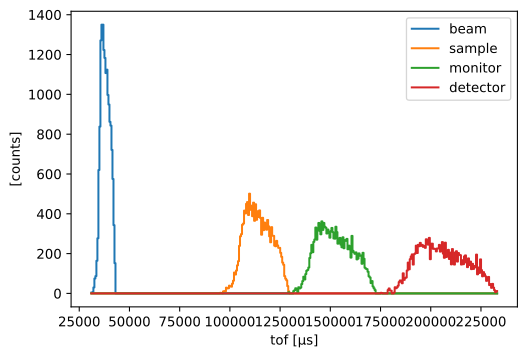
tofs = wf.compute(TofDetector[SampleRun])

tof_hist = tofs.hist(tof=sc.scalar(500.0, unit="us"))
pp.plot({det.name: tof_hist["detector_number", i] for i, det in enumerate(detectors)})
[7]:
Converting to wavelength#
The time-of-flight of a neutron is commonly used as the fundamental quantity from which one can compute the neutron energy or wavelength.
Here, we compute the wavelengths from the time-of-flight using Scippneutron’s transform_coord utility, and compare our computed wavelengths to the true wavelengths which are known for the simulated neutrons.
[8]:
from scippneutron.conversion.graph.beamline import beamline
from scippneutron.conversion.graph.tof import elastic

# Perform coordinate transformation
graph = {**beamline(scatter=False), **elastic("tof")}

# Define wavelength bin edges
bins = sc.linspace("wavelength", 6.0, 9.0, 101, unit="angstrom")

# Compute wavelengths
wav_hist = tofs.transform_coords("wavelength", graph=graph).hist(wavelength=bins)
wavs = {det.name: wav_hist["detector_number", i] for i, det in enumerate(detectors)}

ground_truth = results["detector"].data.flatten(to="event")
ground_truth = ground_truth[~ground_truth.masks["blocked_by_others"]].hist(
    wavelength=bins
)

wavs["true"] = ground_truth
pp.plot(wavs)
[8]:
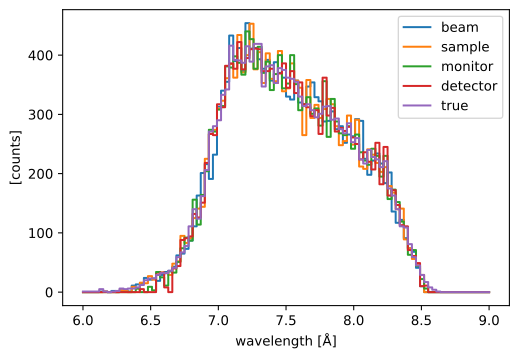
We see that all detectors agree on the wavelength spectrum, which is also in very good agreement with the true neutron wavelengths.
Pulse-skipping mode#
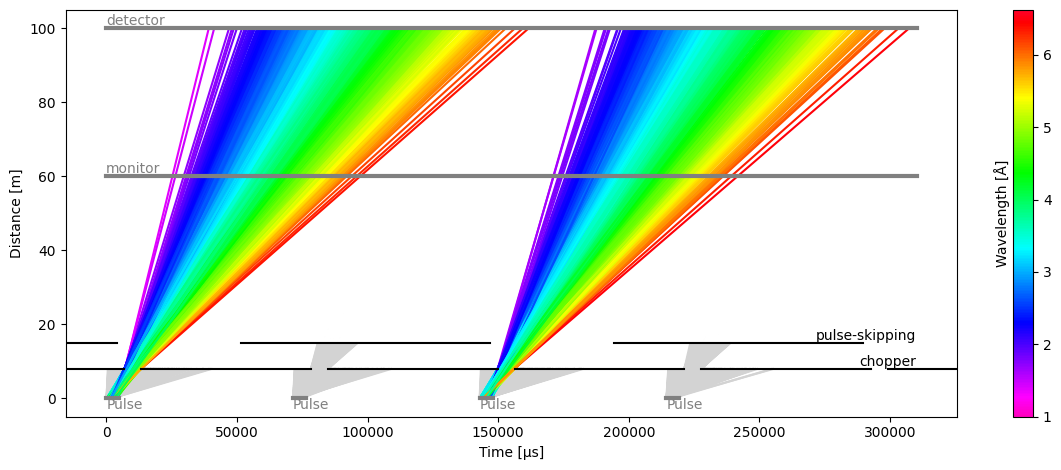
In some beamline configurations, one wishes to study a wide range of wavelengths at a high flux. This usually means that the spread of arrival times will spill-over into the next pulse if the detector is placed far enough to yield a good wavelength resolution.
To avoid the next pulse polluting the data from the current pulse, it is common practice to use a pulse-skipping chopper which basically blocks all neutrons every other pulse. This could also be every 3 or 4 pulses for very long instruments.
The time-distance diagram may look something like:
[9]:
source = tof.Source(facility="ess", pulses=4)
choppers = [
    tof.Chopper(
        frequency=14.0 * Hz,
        open=sc.array(dims=["cutout"], values=[0.0], unit="deg"),
        close=sc.array(dims=["cutout"], values=[33.0], unit="deg"),
        phase=35.0 * deg,
        distance=8.0 * meter,
        name="chopper",
    ),
    tof.Chopper(
        frequency=7.0 * Hz,
        open=sc.array(dims=["cutout"], values=[0.0], unit="deg"),
        close=sc.array(dims=["cutout"], values=[120.0], unit="deg"),
        phase=10.0 * deg,
        distance=15.0 * meter,
        name="pulse-skipping",
    ),
]
detectors = [
    tof.Detector(distance=60.0 * meter, name="monitor"),
    tof.Detector(distance=100.0 * meter, name="detector"),
]

model = tof.Model(source=source, choppers=choppers, detectors=detectors)
results = model.run()
results.plot(blocked_rays=5000)
[9]:
Plot(ax=<Axes: xlabel='Time [μs]', ylabel='Distance [m]'>, fig=<Figure size 1200x480 with 2 Axes>)
Computing time-of-flight#
To compute the time-of-flight in pulse skipping mode, we can use the same workflow as before.
The only difference is that we set the PulseStride to 2 to skip every other pulse.
[10]:
# Lookup table workflow
lut_wf = TofLookupTableWorkflow()
lut_wf[PulseStride] = 2
lut_wf[LtotalRange] = detectors[0].distance, detectors[-1].distance
lut_wf[DiskChoppers[AnyRun]] = {
    ch.name: DiskChopper(
        frequency=-ch.frequency,
        beam_position=sc.scalar(0.0, unit="deg"),
        phase=-ch.phase,
        axle_position=sc.vector(
            value=[0, 0, ch.distance.value], unit=chopper.distance.unit
        ),
        slit_begin=ch.open,
        slit_end=ch.close,
        slit_height=sc.scalar(10.0, unit="cm"),
        radius=sc.scalar(30.0, unit="cm"),
    )
    for ch in choppers
}
lut_wf[SourcePosition] = sc.vector([0, 0, 0], unit="m")
lut_wf[DistanceResolution] = sc.scalar(0.5, unit="m")
The lookup table now spans 2 pulse periods, between 0 and ~142 ms:
[11]:
table = lut_wf.compute(TofLookupTable)

table.plot(figsize=(9, 4))
[11]:
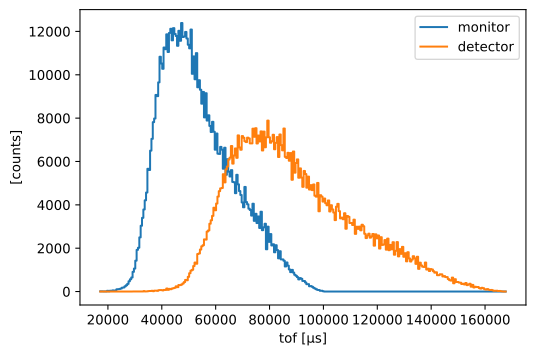
The time-of-flight profiles are then:
[12]:
# Reduction workflow
wf = GenericTofWorkflow(run_types=[SampleRun], monitor_types=[])
nxevent_data = results.to_nxevent_data()
wf[RawDetector[SampleRun]] = nxevent_data
wf[DetectorLtotal[SampleRun]] = nxevent_data.coords["Ltotal"]
wf[NeXusDetectorName] = "detector"
wf[TofLookupTable] = table
wf[LookupTableRelativeErrorThreshold] = {"detector": float("inf")}

tofs = wf.compute(TofDetector[SampleRun])

tof_hist = tofs.hist(tof=sc.scalar(500.0, unit="us"))
pp.plot({det.name: tof_hist["detector_number", i] for i, det in enumerate(detectors)})
[12]:
Conversion to wavelength#
We now use the transform_coords as above to convert to wavelength.
[13]:
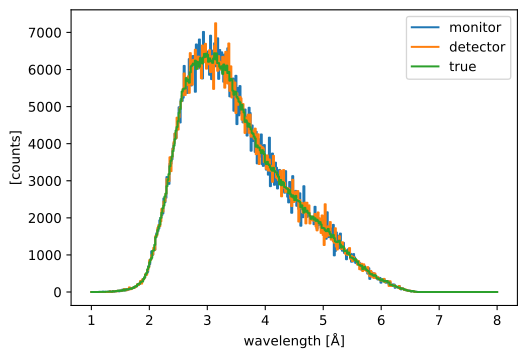
# Define wavelength bin edges
bins = sc.linspace("wavelength", 1.0, 8.0, 401, unit="angstrom")

# Compute wavelengths
wav_hist = tofs.transform_coords("wavelength", graph=graph).hist(wavelength=bins)
wavs = {det.name: wav_hist["detector_number", i] for i, det in enumerate(detectors)}

ground_truth = results["detector"].data.flatten(to="event")
ground_truth = ground_truth[~ground_truth.masks["blocked_by_others"]].hist(
    wavelength=bins
)

wavs["true"] = ground_truth
pp.plot(wavs)
[13]: